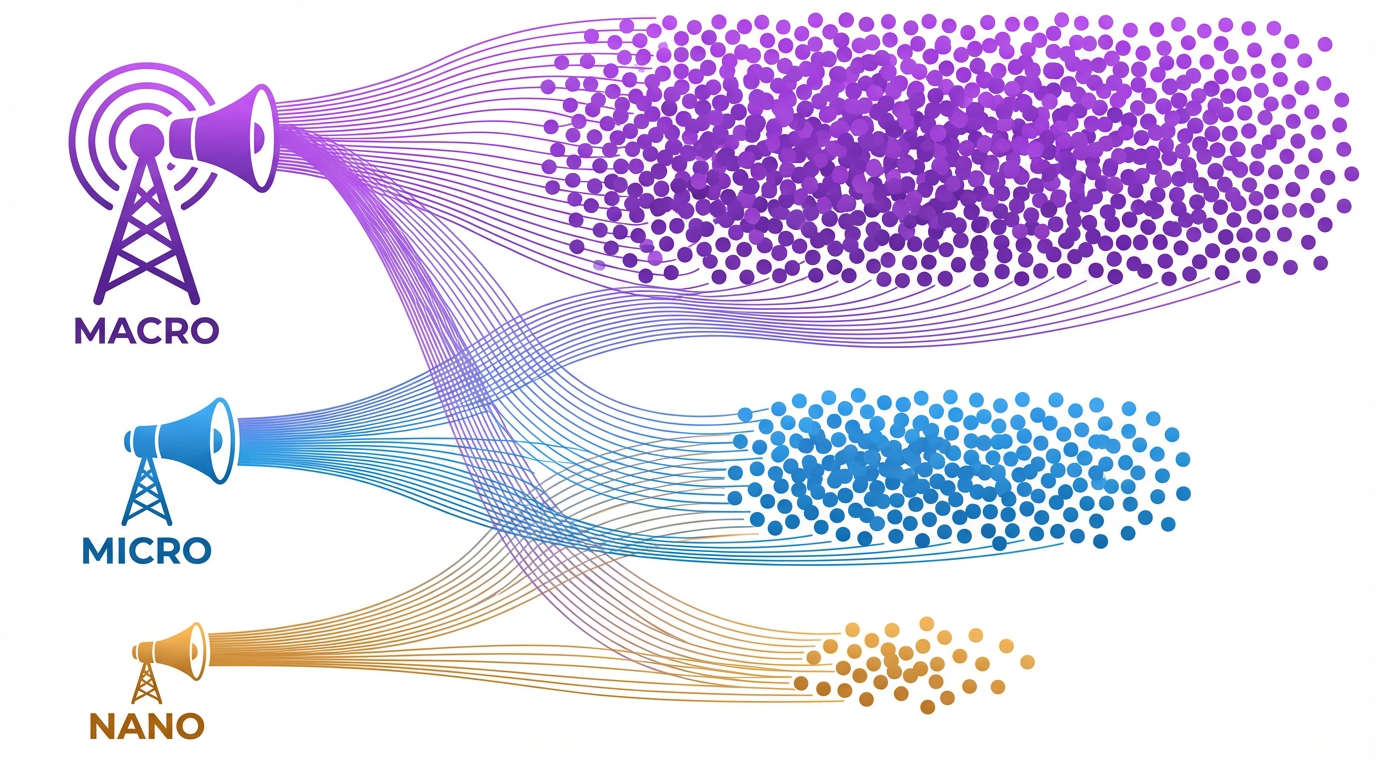
Understanding Influencer Tiers
The influencer marketing landscape has fundamentally changed. Where brands once pursued big-name celebrities, today's most effective strategies often combine multiple creator tiers. Understanding the differences between nano, micro, macro, and mega influencers is essential for optimizing campaign performance.
These tiers aren't arbitrary categories—they reflect real differences in audience size, engagement patterns, content quality, pricing, and most importantly, ROI. Data from Statista, Influencer Marketing Hub, and HypeAuditor consistently shows that smaller creators often deliver superior results.
Influencer Tier Distribution
The influencer landscape is dominated by nano creators: 75.9% of Instagram's influencer base falls into the nano category. This abundance of options makes nano influencers ideal for brands seeking authentic, engaged audiences at reasonable costs.
Engagement Rates by Tier & Platform
The most critical metric for influencer success is engagement rate—the percentage of followers who interact with content through likes, comments, shares, and saves. Higher engagement indicates a more connected audience and typically predicts better conversion rates.
A striking pattern emerges when you compare engagement across influencer tiers: smaller creators consistently outperform larger ones. This inverse relationship between follower count and engagement rate contradicts the intuition that "bigger is always better."
| Influencer Tier | Followers | TikTok Engagement | Instagram Engagement | YouTube Engagement |
|---|---|---|---|---|
| Nano | 1K - 10K | 10.3% | 4.8% | 3.2% |
| Micro | 10K - 100K | 8.1% | 2.4% | 2.1% |
| Mid-Tier | 100K - 500K | 6.3% | 1.8% | 1.5% |
| Macro | 500K - 1M | 5.5% | 1.5% | 1.2% |
| Mega | 1M+ | 4.9% | 1.2% | 0.9% |
Sources: Statista Influencer Engagement Rates 2025, HypeAuditor 2025 Study, Influencer Marketing Hub Analysis
The engagement differential is substantial. Nano influencers achieve 10.3% engagement on TikTok compared to 4.9% for mega influencers—more than double the rate. On Instagram, nano influencers hit 4.8% versus 1.2% for mega influencers—a 4x difference.
Why Nano Outperforms Mega
- Audience intimacy: Nano creators have personal relationships with followers. Many respond to comments, remember recurring viewers, and feel authentic conversations rather than broadcasts.
- Niche expertise: Nano influencers typically focus on specific topics and attract highly targeted, passionate communities rather than casual observers.
- Content authenticity: Smaller creators often maintain genuine content practices, while mega influencers face pressure to produce polished, commercial content.
- Lower follow-through fatigue: With fewer posts from each creator, audiences remain engaged rather than experiencing algorithm burnout.
- Algorithm advantages: Platforms reward authentic engagement, which nano creators typically provide in abundance.
Engagement rate is a better predictor of campaign success than follower count. A nano influencer with 5,000 followers and 10% engagement (500 engaged people) may deliver better results than a mega influencer with 2 million followers and 1.5% engagement (30,000 engaged people) if targeting quality over quantity.
Complete Pricing Data (2026)
Influencer pricing varies dramatically based on creator tier, platform, content format, industry, and negotiation. Here's what brands can expect to pay across the entire spectrum:
| Tier | Followers | Single Post (Avg) | Monthly Campaign (3-5 posts) | Per 1,000 Impressions |
|---|---|---|---|---|
| Nano | 1K - 10K | $10 - $100 | $50 - $250 | $5 - $50 |
| Micro | 10K - 100K | $100 - $500 | $300 - $1,500 | $2 - $10 |
| Mid-Tier | 100K - 500K | $500 - $5,000 | $2,000 - $15,000 | $1 - $5 |
| Macro | 500K - 1M | $5,000 - $10,000 | $15,000 - $40,000 | $1 - $3 |
| Mega | 1M+ | $10,000+ | $40,000+ | $0.50 - $2 |
Source: Kolsquare 2025 Influencer Pricing Study, Influencer Marketing Hub Rate Calculator
Platform-Specific Pricing
Pricing varies significantly by platform due to differences in audience size, engagement rates, and monetization models:
| Tier | TikTok Video | Instagram Reel | Instagram Story | YouTube Video |
|---|---|---|---|---|
| Nano (1-10K) | $5 - $25 | $10 - $100 | $5 - $50 | $20 - $200 |
| Micro (10-100K) | $25 - $150 | $100 - $500 | $50 - $250 | $200 - $1,000 |
| Mid-Tier (100-500K) | $150 - $1,500 | $500 - $5,000 | $250 - $1,500 | $1,000 - $10,000 |
| Macro (500K-1M) | $1,500 - $3,000 | $5,000 - $15,000 | $1,500 - $3,000 | $10,000 - $25,000 |
| Mega (1M+) | $3,000+ | $15,000+ | $3,000+ | $25,000+ |
Source: Influencer Marketing Hub 2026 Pricing Study, HypeAuditor Analysis
✓ Nano Influencer Pricing Advantages
- Lower per-post costs ($10-100)
- Work with 50+ creators per budget
- Better cost-per-engagement ratio
- Accessible for smaller budgets
- Higher ROI potential
✗ Macro/Mega Influencer Costs
- High per-post fees ($5K-100K+)
- Limited creators per budget
- Higher risk if underperforms
- Requires significant budget allocation
- Lower engagement rates
Characteristics of Each Tier
Nano Influencers (1K-10K Followers)
Definition: Creators with 1,000 to 10,000 followers, typically operating in specific niches with highly engaged, dedicated audiences.
Characteristics:
- Engagement: 10.3% on TikTok, 4.8% on Instagram—the highest among all tiers
- Authenticity: Often maintain genuine, non-commercial content style
- Audience: Highly targeted, passionate communities around specific topics
- Cost: $10-100 per post ($5-50 per 1,000 impressions)
- Volume: 75.9% of Instagram influencers fall into this category
- Response rates: Often respond to DMs, build community relationships
Best for: Brand awareness, niche communities, product seeding, gathering authentic reviews, building long-term relationships
Micro Influencers (10K-100K Followers)
Definition: Creators with 10,000 to 100,000 followers, having established credibility in their areas of focus.
Characteristics:
- Engagement: 8.1% on TikTok, 2.4% on Instagram
- Balance: Combine reach with engagement, providing good middle ground
- Experience: Often have experience with brand partnerships
- Cost: $100-500 per post ($2-10 per 1,000 impressions)
- Professional practices: Typically have media kits and clear rates
- Accessibility: Still approachable for mid-size budgets
Best for: Balanced campaigns, product launches, affiliate marketing, influencer networks, geographic targeting
Macro Influencers (500K-1M Followers)
Definition: Creators with 500,000 to 1 million followers, typically with significant reach and commercial experience.
Characteristics:
- Engagement: 5.5% on TikTok, 1.5% on Instagram
- Reach: Significant viewership numbers, excellent for awareness
- Professionalism: Managed by agencies, have professional workflows
- Cost: $5,000-10,000 per post ($1-3 per 1,000 impressions)
- Expertise: Often celebrity-adjacent with brand deal experience
- Scalability: Can deliver significant impressions in single campaigns
Best for: Mass awareness campaigns, celebrity endorsements, large brand launches, reaching multiple demographics
Mega Influencers (1M+ Followers)
Definition: Creators with 1 million or more followers, often celebrities or entertainment figures.
Characteristics:
- Engagement: 4.9% on TikTok, 1.2% on Instagram—lowest among all tiers
- Reach: Massive viewership but often includes casual audiences
- Cost: $10,000+ per post ($0.50-2 per 1,000 impressions)
- Management: Requires agency representation, complex negotiations
- Risk: High upfront cost with no performance guarantees
- Passive audiences: Many followers don't actively engage
Best for: Maximum reach requirements, PR value, brand prestige, entertainment-focused products
ROI Analysis: Which Tier Wins?
When evaluating ROI, the calculation isn't simply dividing cost by reach. True ROI accounts for engagement quality, conversion likelihood, and long-term value. Here's how the tiers compare:
Cost Per Engagement
This metric reveals the true cost efficiency of each tier by dividing total cost by engaged audience members:
| Tier | Cost per Post | Avg Engagement (TikTok) | Engaged Users | Cost per Engagement |
|---|---|---|---|---|
| Nano (5K avg) | $50 | 10.3% | 515 users | $0.10 |
| Micro (50K avg) | $250 | 8.1% | 4,050 users | $0.06 |
| Macro (750K avg) | $7,500 | 5.5% | 41,250 users | $0.18 |
| Mega (2M avg) | $20,000 | 4.9% | 98,000 users | $0.20 |
Finding: Micro influencers deliver the best cost-per-engagement at $0.06, followed by nano at $0.10. Macro and mega influencers cost 1.8-3.3x more per engagement. However, engagement alone doesn't capture the full picture—quality matters.
For most brands, a portfolio approach combining nano (for authenticity and engagement) and micro (for scale and professionalism) delivers superior ROI compared to relying on any single tier.
Platform-Specific Performance
TikTok Performance by Tier
TikTok shows the most dramatic differences between tiers. The platform's algorithm doesn't favor followers—it favors engaging content. This makes smaller creators highly competitive.
- Nano: 10.3% engagement (highest potential for viral reach)
- Micro: 8.1% engagement (strong reliability)
- Macro: 5.5% engagement (still substantial, consistent reach)
- Mega: 4.9% engagement (massive reach but lower engagement density)
Instagram Performance by Tier
Instagram shows smaller engagement differentials between tiers but still favors smaller creators significantly:
- Nano: 4.8% engagement (highly dedicated followers)
- Micro: 2.4% engagement (balanced performance)
- Macro: 1.5% engagement (lower interaction rates)
- Mega: 1.2% engagement (passive audience predominates)
YouTube Performance by Tier
YouTube engagement rates are generally lower across all tiers but reflect different content dynamics (longer watch times, different interaction types):
- Nano: 3.2% engagement (community-focused content)
- Micro: 2.1% engagement (established channels)
- Macro: 1.2% engagement (entertainment-focused)
- Mega: 0.9% engagement (celebrity status)
When to Use Each Influencer Tier
Choose Nano Influencers When:
- Your budget is limited (under $5,000)
- You want highly engaged, niche audiences
- You seek authentic, genuine endorsements
- You're testing new products or markets
- You want to build long-term creator relationships
- You prioritize engagement over reach
- Your brand serves specific communities
Choose Micro Influencers When:
- Your budget is moderate ($5,000-$25,000)
- You need balance between reach and engagement
- You want established, professional creators
- You're launching new products
- You seek geographic or demographic targeting
- You want creator networks for scale
- You need measurable affiliate performance
Choose Macro Influencers When:
- Your budget allows ($25,000+)
- You need significant reach quickly
- You're launching major products or campaigns
- You want agency-managed professional campaigns
- You're targeting broad demographics
- You seek celebrity association value
- You prioritize reach over engagement
Choose Mega Influencers When:
- Your budget is substantial ($50,000+)
- Maximum reach is the primary goal
- PR and media coverage matter
- You're a major brand with significant budgets
- You seek celebrity endorsement value
- You're targeting mass-market entertainment audiences
- Long-term brand building is the priority
Campaign Strategy by Budget
Limited Budget ($500-$2,500): Nano-Focused Strategy
Approach: Work with 15-25 nano influencers in your niche
- Identify creators in your specific niche with 2K-8K followers
- Reach out with personalized pitches (not mass emails)
- Offer product + modest payment ($20-50 each) or product-only for organic seeding
- Provide brief guidelines but allow creative freedom
- Track results using discount codes and UTM parameters
- Double down on top performers for future campaigns
Medium Budget ($2,500-$10,000): Nano + Micro Mix
Approach: Combine 10 micro influencers with 30 nano influencers
- Allocate 40% to 10 micro influencers ($250/each) in core niches
- Allocate 60% to 30 nano influencers ($50/each) across related niches
- Use consistent campaign messaging across all tiers
- Collect performance data: engagement, clicks, conversions
- Identify top performers for subsequent campaigns
- Consider affiliate partnerships with top-performing creators
Large Budget ($10,000-$50,000): Tiered Pyramid Strategy
Approach: Use multiple tiers for different campaign objectives
- Awareness layer (50%): 5 macro influencers ($5K each) for broad reach
- Engagement layer (30%): 15 micro influencers ($200/each) for authentic endorsement
- Conversion layer (20%): 40 nano influencers ($25/each) for community infiltration
- Create different messaging for each tier
- Run A/B tests across influencer types
- Measure funnel performance from awareness to conversion
Enterprise Budget ($50,000+): Integrated Multi-Channel Strategy
Approach: Comprehensive campaigns across all tiers and platforms
- Strategic partnerships: 2-3 mega influencers for PR value ($15K-30K each)
- Mass awareness: 10 macro influencers ($5K each) across platforms
- Core advocacy: 50 micro influencers ($300/each) with affiliate programs
- Grassroots amplification: 100+ nano influencers ($50/each) for community depth
- Integrated tracking across all channels and tiers
- Real-time optimization and scaling based on performance
- Long-term relationship building for sustainable future campaigns
Related Resources
Frequently Asked Questions
What are the differences between nano, micro, macro, and mega influencers?
Influencer tiers are categorized by follower count and performance metrics. Nano influencers have 1K-10K followers and achieve 10.3% average engagement on TikTok, costing $10-100 per post. Micro influencers have 10K-100K followers, deliver 8.1% engagement, and cost $100-500 per post. Macro influencers have 500K-1M followers, achieve 5.5% engagement, and cost $5,000-10,000 per post. Mega influencers have 1M+ followers, deliver 4.9% engagement, and charge $10,000+ per post. The key pattern: engagement rates decrease as follower counts increase.
Which influencer tier has the best ROI?
For most brands, nano and micro influencers deliver the best ROI. Nano influencers achieve the highest engagement rates (10.3% on TikTok), lowest costs ($10-100 per post), and result in $0.10 cost-per-engagement. Micro influencers offer better cost-per-engagement ($0.06) with slightly lower engagement but larger total reach. Macro and mega influencers cost 2-4x more per engagement despite lower engagement rates. However, if your goal is pure reach/awareness, macro influencers may be worth the investment.
How much does it cost to work with each influencer tier?
Nano influencers charge $10-100 per post ($5-50 per 1,000 impressions). Micro influencers charge $100-500 per post ($2-10 per 1,000 impressions). Macro influencers charge $5,000-10,000 per post ($1-3 per 1,000 impressions). Mega influencers charge $10,000+ per post ($0.50-2 per 1,000 impressions). Costs vary by platform (TikTok is typically cheapest), niche, content format, and contract length. Some nano/micro influencers accept product-only partnerships for authentic seeding.
Why do nano influencers have higher engagement rates than mega influencers?
Nano influencers have closer personal relationships with their audiences. Their followers are typically passionate community members rather than passive observers. Mega influencers' massive followings include many casual viewers who rarely interact. Additionally, nano influencers often maintain authentic content practices, while mega influencers produce polished, commercial content. Finally, smaller audiences experience less algorithm burnout—followers stay engaged rather than becoming overwhelmed by volume.
Should I work with one macro influencer or multiple nano influencers?
For ROI, multiple nano influencers typically outperform one macro influencer. One macro influencer at $7,500 with 5.5% engagement reaches approximately 41,250 engaged people. The same $7,500 working with 150 nano influencers at $50 each with 10.3% engagement reaches approximately 77,250 engaged people—more than 87% additional engagement for the same cost. Additionally, diversification reduces risk: if one nano influencer underperforms, others compensate. However, if your primary goal is maximum reach or PR value, a macro influencer may be worth the higher cost.
Which platforms have the highest engagement rates by influencer tier?
TikTok has the highest engagement rates across all influencer tiers: 10.3% for nano, 8.1% for micro, 5.5% for macro, and 4.9% for mega. Instagram shows moderate engagement: 4.8% nano, 2.4% micro, 1.5% macro, and 1.2% mega. YouTube engagement is lower overall but reflects different interaction patterns: 3.2% nano, 2.1% micro, 1.2% macro, and 0.9% mega. TikTok's algorithm advantage makes it ideal for small creators seeking viral potential.
How should I allocate budget across influencer tiers?
For optimal ROI, allocate budget proportionally to engagement potential: with $10,000 budget, allocate 50% to nano influencers (10-20 creators), 35% to micro influencers (7-10 creators), and 15% to macro influencers (1-2 creators). This pyramid approach balances authentic grassroots engagement with professional reach. Adjust based on your goals: increase nano for engagement/authenticity focus, increase macro for reach-focused awareness campaigns.
Ready for Guaranteed Results?
Instead of negotiating with individual influencers, use organic media buying to get guaranteed views at $6 CPM across a network of 1,900+ creators.
Get Your Campaign Plan